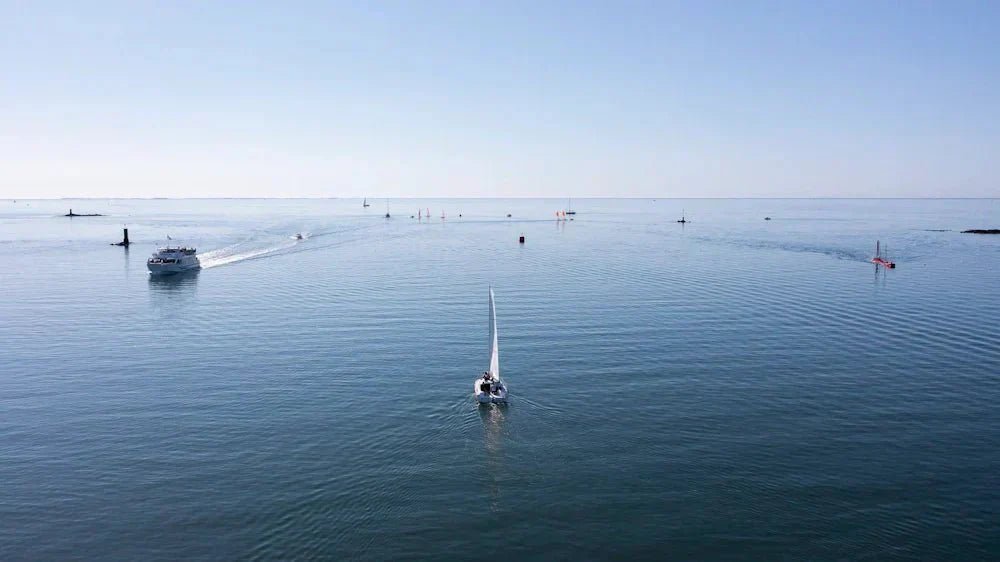
It's common knowledge that an electric motor is quieter in the air than its combustion engine equivalent. But what about underwater? To what extent? And what are the impacts on wildlife? When you delve into the subject, you find a lack of comparative data, especially for recreational boating.
At TEMO, we wanted to understand and gain a better grasp of the subject. Our goal is to improve our knowledge of noise emissions (thermal and electrical) and identify ways to reduce them for our future developments, with one ultimate aim: to minimize our acoustic impact on the marine environment. To this end, research was conducted within TEMO and in partnership with ENSTA Bretagne (École Nationale Supérieure des Techniques Avancées Bretagne).
Underwater noise pollution : a reality that makes more noise than it seems.
The subject is as fascinating as it is complex: it's a discipline in itself. It involves waves, formulas, a wealth of scientific knowledge, and a profusion of biodiversity. In this universe, our engines are part of anthropogenic noise : a discordant sound resulting from human activity. Logically, our exploration begins with measuring the emissions of our engines and their thermal equivalents.
Scientific diving with ENSTA Bretagne.
Let's turn to the experts, those from ENSTA, who helped us to get a head start on a project that turned out to be quite extensive. Measuring and analyzing sounds, especially in aquatic environments, is not something that can be improvised. The research professors at this renowned engineering school, a member of the Institut Polytechnique de Paris, have a complete mastery of their subject.
|
In June 2024, at Lake Guerlédan, they made and analyzed our first recordings, which were then refined internally during the following winter. At the same time, we compiled as much ethological knowledge as possible. After a long and patient process of analysis, the sound waves gradually transformed into numbers, then into curves: we finally had robust elements of comparison , within a well-defined reference frame. |
 |
Ethology? It's the study of animal behavior. If we make noise, we need to understand why and how it can be disruptive to those species. And we're fortunate in France to have a wealth of experts: just in French alone, there's plenty to read!
The " superpower " of sound.
Let's return for a moment to the specific characteristics of aquatic environments for sound propagation : acceleration, greater distance, and strong dependence on environmental parameters. For underwater life , in the absence of light, acoustics is the universal and vital tool.
It helps you orient yourself, hunt, and detect dangers. The density of the water facilitates the transmission of energy from one point to another and the propagation of low-frequency waves . By putting your head underwater, you'll hear sounds from further away, more clearly, and much sooner than you can perceive them in the air. It's almost like a "superpower."
From wave to behavior: the wave of life.
At this stage, to fully understand the potential impacts of human-generated noise on wildlife, it's necessary to move beyond our human frame of reference. This is the role of ethologists, whose painstaking research has enabled them to create audiograms for various marine species: mammals, of course, but also fish, mollusks, and other invertebrates. Human hearing ranges from approximately 20 Hz to 2 kHz. Mammals, unsurprisingly, are somewhat similar to us. Among them, toothed whales, including the iconic bottlenose dolphin, use vocalizations between 0.2 and 50 kHz for their social interactions. The echolocation clicks they use for navigation (which could be compared to our sonar) utilize a frequency band between 40 and 150 kHz. This very wide range of perception far exceeds human capabilities. Fish, for their part, mostly interact at frequencies below 1 kHz. This information helps us understand that the same sound wave will affect different species differently depending on their hearing capabilities.
Obscuration : the main impact of recreational boating.
There are also several types of noise impact: for recreational boating, masking is the most significant. This corresponds to the " interference " by anthropogenic noise with the frequencies used by species to communicate or navigate. The masked sounds are no longer perceptible to the species. This masking can induce vital behavioral disturbances, particularly affecting reproductive success and social cohesion, potentially harming the health of a population through a decline in population size and juvenile survival (Gallagher et al., 2021; Mortensen et al., 2021).
|
Measurement indicators in acoustics In underwater acoustics, numerous indicators exist for quantifying sound levels. Sound pressure levels (SPL) are measured in dB SPL re1μPa@1m. Based on a logarithmic scale (decibels), the ratio between a measured sound pressure (in Pa) 1m from its source (@1m) and a reference (1μPa, the threshold of human hearing underwater) is represented. The decibel scale allows for the representation of large amplitude differences. A variation of 20 dB represents a wave 10 times louder, and 40 dB a wave 100 times louder. With this in mind, we chose the speed of the dinghy we used as our basis for comparison. Thus, the measured sound level differences correspond to the same engine usage. |
Quantifying noise using spectral density .
The most relevant representation in our case is that of spectral density . It allows us to display the sound level for a given frequency. We chose to construct curves over a frequency band between 180 Hz and 45 kHz. This method is particularly useful for determining which frequencies are the loudest.

Figure 1: Spectral density of the 4 measured motors (TEMO study)
Electric versus thermal : what do the measurements tell us?
The first observation is the stronger and more consistent contribution of internal combustion engines to noise levels . Regardless of frequency, their sound levels are stable and higher. For electric motors, the contributions are more concentrated in specific frequency ranges . Furthermore, while the average differences are less pronounced than with airborne noise, they average around 10 dB SPL, meaning that internal combustion engines are five times louder . To draw a comparison, this would be the difference between a quiet restaurant and a noisy classroom! The differences are more noticeable at lower frequencies and tend to narrow at higher frequencies.
In electric vehicles, the motors are generally quieter. and occasional contributions.
For electric motors (and particularly the T450), peaks appear below 2 kHz, with occasional spikes that can equal those of internal combustion engines. These are likely attributable to the propeller . High-frequency spectral lines appear on the T1000's spectrum. At three distinct and specific frequencies, their noise level reaches or exceeds that of internal combustion engines. These are attributed to the power electronics (PWM for Pulse Width Modulation) which allows the motor speed to be varied.
In summary , there is stronger masking of low-frequency communications for internal combustion engines.
A generally higher noise level, particularly at low frequencies: this is the conclusion we can draw from the noise emissions of the internal combustion engines we tested. Since low frequencies propagate more easily, this contribution across a broad spectrum will mask more frequencies useful to wildlife, and over a wider area. This is the general conclusion we can draw from these results. The values observed for these low-power engines (electric and internal combustion combined), even accounting for instrumental error, do not appear sufficient to cause harm to wildlife, even temporary harm . Their impact is more behavioral. We can target a few species, but it is difficult to determine precise impacts, as interactions also exist, and disturbing certain species can disrupt the balance of an ecosystem. Our study does not extend that far.
These results were confirmed by two European studies.
Although few experiments directly compare internal combustion and electric motors, recent studies have obtained fairly similar results. This is the case for the publications by Aradi et al in May 2024, and Gaggero et al in February 2024. The former observed an average difference of 10-15 dB SPL, while the Italian study obtained a difference of 5-7 dB for its scenario (2 Torqueedo motors versus a 40 HP outboard motor).

Figure 2: Noise level for electric boat (EB) and internal combustion engine boat (CEB) moving at 4 and 6 knots (Gaggero et al., 2024).
| The Italian study proposes a model of masking for two species (the brown meagre - a species of fish and the bottlenose dolphin). |
In all cases, the authors highlight, for electric motors, a significantly smaller contribution in the low frequencies and emissions of high-frequency lines due to PWM.

Figure 3: Calculated masking perimeter for the corb (one-third octave band 315 Hz) (Gaggero et al., 2024)
- a: internal combustion engine
- b: electric motor
Our own measurements also show a rapid attenuation of emissions from electric motors : at 30m, they are only distinguishable from ambient noise at a few frequencies, unlike internal combustion engines which remain largely audible. Their results support this finding by showing reduced impact zones for electric motors (Figure b).

Figure 4: Spectral density of the 4 motors, measured at 30m from the source (TEMO study)
The contribution of electric motors to reducing anthropogenic noise and its impacts is therefore largely positive, as also demonstrated by a comparative Australian study between an electric ferry and a conventional ferry (Parsons et al., 2020). However, the new impacts specific to certain species and due to power electronics must continue to be studied in detail. Above all, this aspect must be included in our specifications to pursue and amplify impact reductions and become one of the major challenges for our engineering teams , along with propeller design.
Electric motors adapted to real-world uses .
These strict results also mask another reality that the logistics of our tests brought to light. Typical use cases in boating are short trips (boat-to-shore), coastal fishing, and motorized excursions. In all of these use cases, approach maneuvers are regularly performed, the boating speed is mostly maintained, and there are regular periods of drifting with the engine running.
All of these use cases fully justify the use of electric motors , because not only do they allow us to take advantage of the technical benefits of the technology, but they also represent the situations in which the differences in noise emissions between the two technologies will be most pronounced:
- No noise when the electric motor is stopped;
- Very low noise from the electric motor at low speed (approach maneuvers);
- The difference in low-speed propulsive efficiency between the two technologies results in greater vibration reduction within these operating ranges. The maximum torque readily available from the electric motors helps to delay the onset of propeller cavitation.
Results and ambition.
While our measurements and existing studies have confirmed our intuitions and the merits of developing electric technology, they have also highlighted its current limitations and areas for improvement. We emerge from this state-of-the-art review enriched by the beauty of marine biodiversity and the responsibility we bear, for on the oceans, we are merely guests . This knowledge compels us.
| " Hasten slowly, and without losing courage. Twenty times over, put your work back on the loom. " These verses by Nicolas Boileau resonate at a time when poetry and technique, technology and the science of life must be combined. |  |
No challenge is insurmountable if you pursue the right goal. And the goal we've set for ourselves at TEMO is to continue reducing our impact . To achieve this, we've identified two key areas:
- Continue our efforts to raise awareness of the impacts of recreational boating and ways to reduce them.
- Integrating underwater noise into our environmental challenges.
Regarding this last point, we are mobilizing our engineering department to pursue noise reduction objectives for power electronics, as well as for propeller design. The challenge is immense and goes beyond the simple success of TEMO. This is why we also hope that this article can serve as a call to action for all those willing to work towards this goal, and perhaps even as an opportunity to create an industrial collective motivated to achieve these objectives.
Alone we go faster; together we go further; let us hasten slowly!
Speed is none of our business, cooperation is.