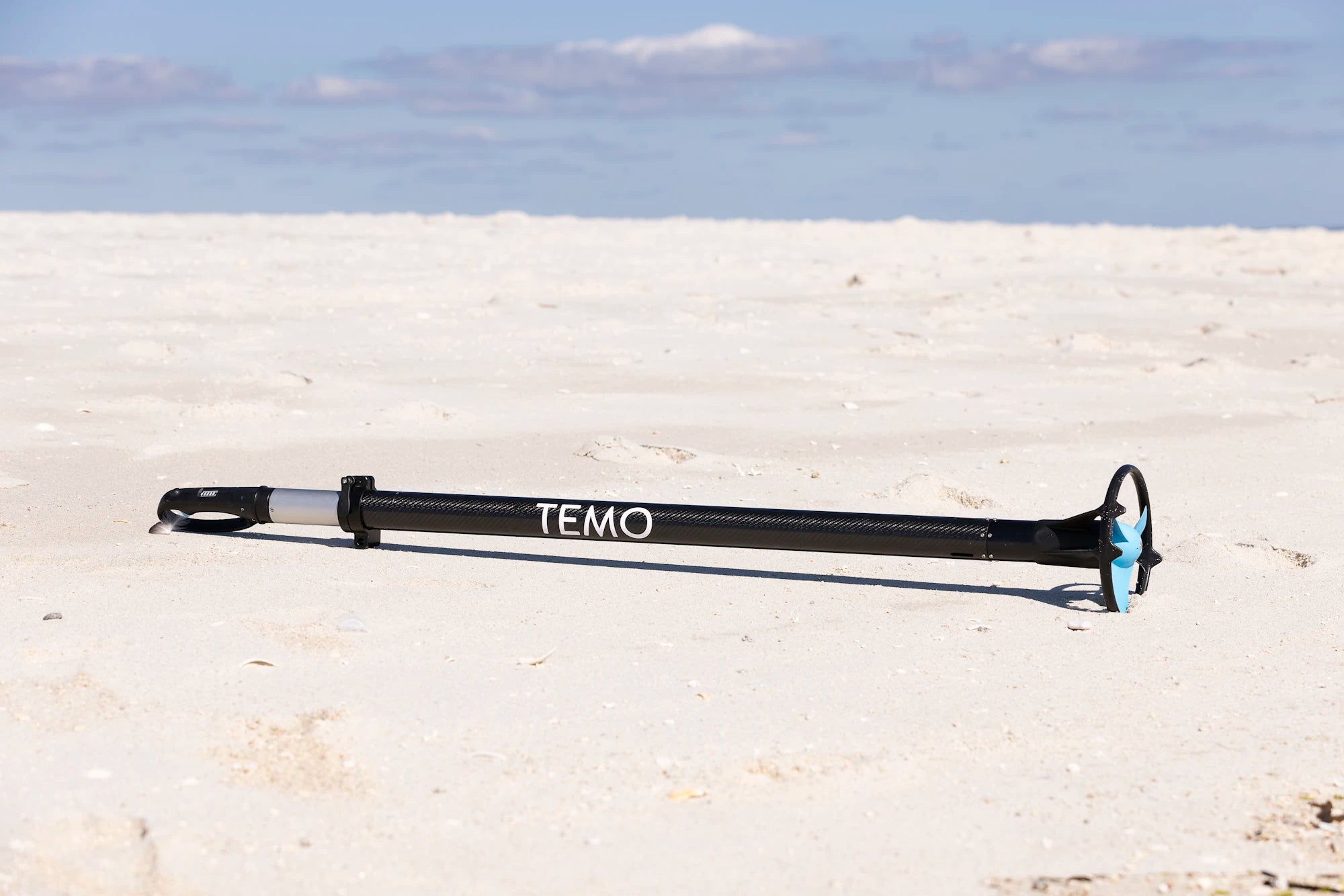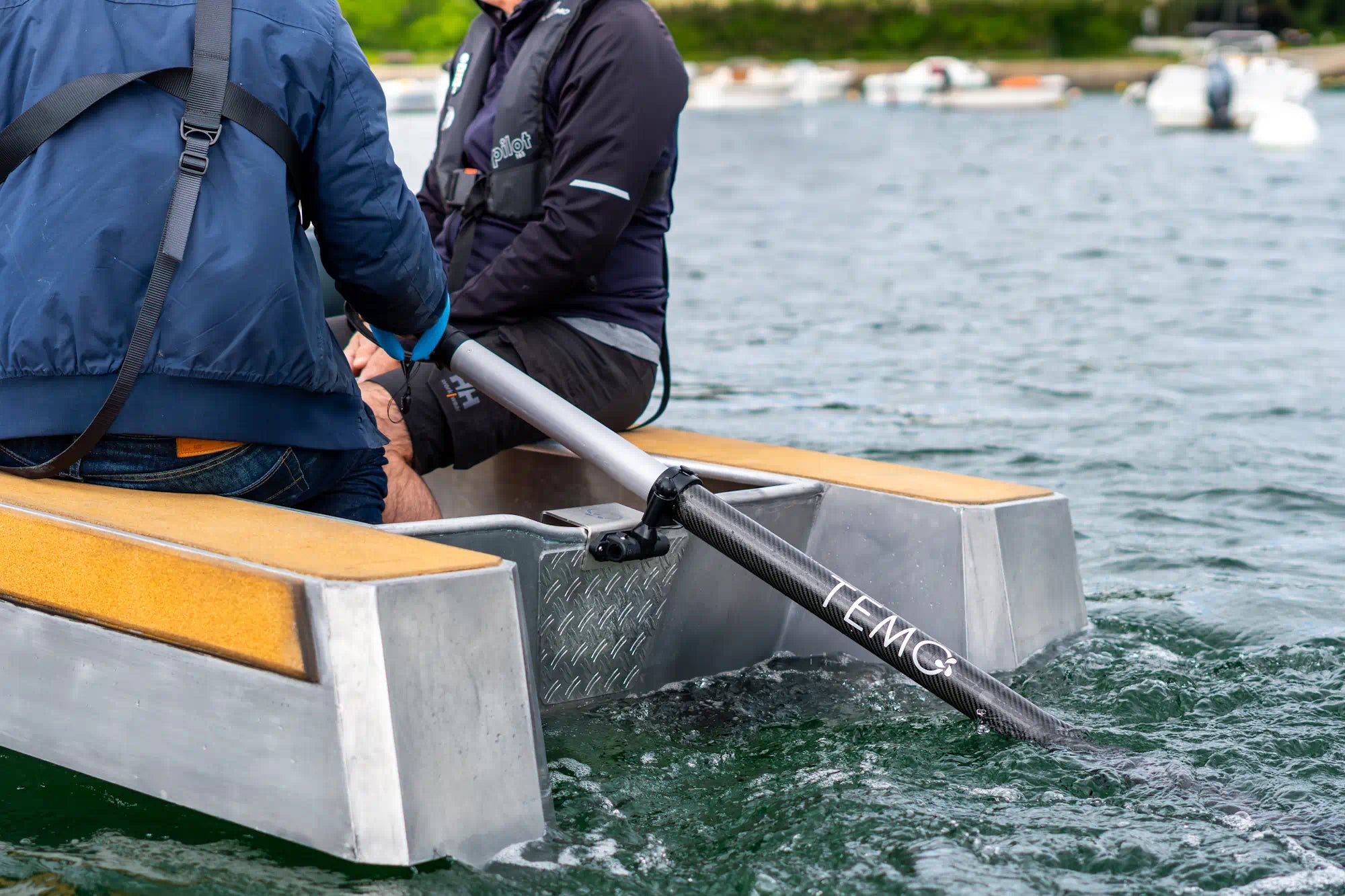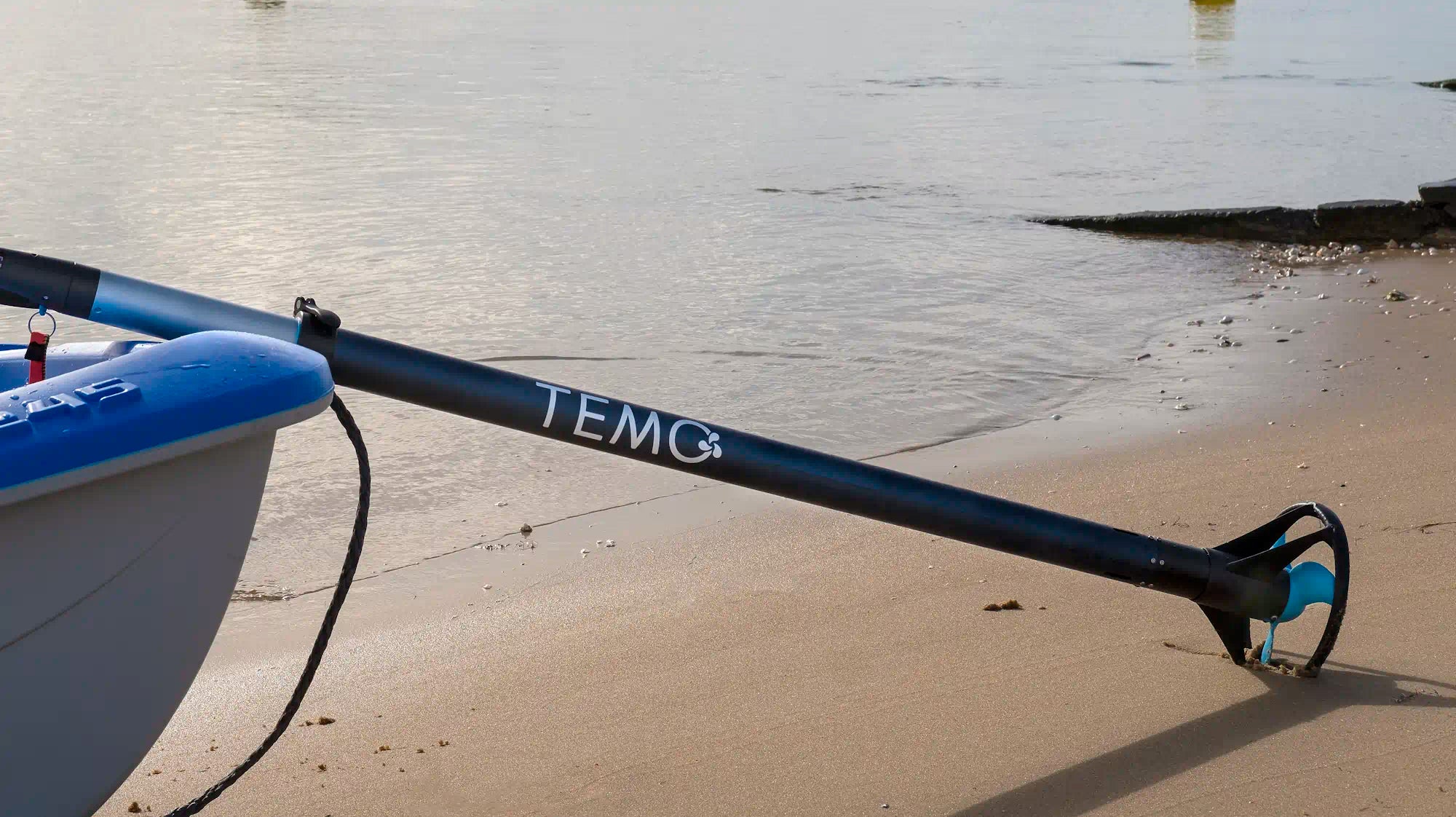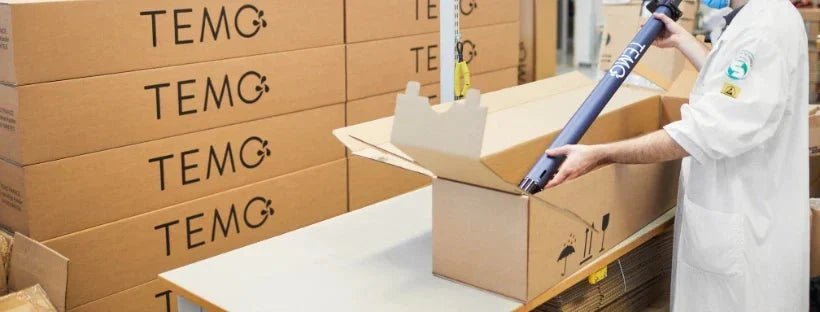
TEMO manufacturing process: packaging with our partner ESAT ARTA.
Since TEMO's inception, we have been committed to developing innovative products and accessories that are as environmentally friendly as possible, and we partner with local businesses and organizations to successfully complete each stage of our project, whether it involves:
- Product design
- The choice of materials
- Our portable power tool is manufactured and assembled in France.
- Logistics
- The conditioning
To support us in this final stage, we have called upon a medical-social establishment that has worked alongside us from the beginning and contributes to the success of TEMO. This is the ESAT (establishment and services for assistance through work) ARTA located in Saint-Sébastien-sur-Loire, on the outskirts of Nantes.
Today we take you to meet Michelle Costantini (workshop instructor), Michel Guilbault (production manager) and Antoine Decré (operations manager). Three of the key players in this medical-social establishment.
Hello to the three of you, can you describe ESAT ARTA in a few words?
ESAT ARTA supports any person with a disability following a brain injury through adapted employment .
The consequences of a brain injury or the aftermath of a coma inevitably disrupt their family, social, and professional lives. This necessitates defining a new path, based on different foundations and with adapted resources. At ESAT ARTA , our role is to empower them , ensuring they feel heard and understood within a protected work environment , far more suitable than a so-called "traditional" company.
The ESAT is part of VYV3 Pays de la Loire, which belongs to the VYV mutual group, the leading private solidarity-based operator in France and the leading mutual player in health and social protection . Working closely with local communities, VYV, through the diversity of its services and the strong commitment of its 4,100 employees and 180 elected representatives, develops and manages a range of care and services organized around three core business areas (medical services and goods, support and care, and elderly care).
How many people work at the Saint-Sébastien-sur-Loire site and how do they get to you?
We have 100 employees with disabilities. on the site of Saint-Sébastien-sur-Loire.
The admission process is quite complex. It is the MDPH (Departmental House for Disabled Persons) that proposes to direct a person towards an ESAT like ours, or to direct them towards a traditional company.
Upon admission to an ESAT (Establishment and Service for Assistance through Work), a worker signs a work support contract outlining the commitments of both parties. Based on each individual's abilities, skills, and career plan, the ESAT proposes assigning them to a specific workshop.
How many different business sectors do you have?
Our business activities are very diverse, but our three main services are laundry, machine shop, and packaging . Laundry is our largest department; we handle a ton of laundry every day. We can wash and fold Airbus work clothes, run cables for the electronics industry, and package a variety of products.
What is special about hiring people with disabilities due to brain injury?
Every person is unique . It's a bit of a cliché, and it's true even outside of a sheltered workshop, but there's a "before" and an "after" a brain injury. First of all, the level of fatigue experienced by someone who has suffered a traumatic brain injury is extremely high. As a result, more than 50% of our workers are part-time. This is almost essential to allow everyone to contribute to production according to their abilities. Furthermore, cognitive impairments, a major consequence of brain injury, lead the teams to adapt each project to the individual worker.
Work is a tool for these individuals to develop or maintain their skills , and it's wonderful to see their level of engagement. They are all very dedicated, and we support them so they feel as comfortable as possible in their roles.
And even if they decide to leave the ESAT, we have a duty and an obligation to support them in a new life path, to find a solution with them , so that the "exit" goes as smoothly as possible.
Another distinctive feature of these workers is that they are not employees of our establishment. They have a work support and assistance contract, not an employment contract as such. This is the same situation in all ESATs (sheltered workshops).
How many clients do you have and how does the integration of new projects go?
We have approximately 150 regular clients . Integrating new clients or new projects requires a delicate balance between business development and production capacity. Typically, when a client calls, Antoine Decré (Operations Manager) discusses their needs and analyzes them. With the support of Michel Guilbault (Production Manager) and his 15 years of experience at the ESAT (a sheltered workshop for people with disabilities), they assess the feasibility of a collaboration.
The mission must be neither too short nor too complex, and above all, never rushed. Implementing each process, each task, is a lengthy and demanding process.
For a project a client wishes to entrust to us, we may decide to undertake it in its entirety, if possible, or to carry out only certain processes. We review all the feasible aspects, prepare a quote and a timeline, and then validate it with the client.
How is the production chain set up?
It's essential to adapt to each employee. The role of the supervisors is to design, create, and adapt the production line . They know how to organize their teams, which person will be assigned to a new task, and so on. They will do everything possible to simplify tasks as much as possible, from the smallest task to the most complex process.
An instructor typically supervises 13 people to get to know them thoroughly. They understand each person's limitations and adapt accordingly. This might involve printing out explanatory notes or photos showing the distribution of specific parts. Some workers might be focused on a task, turn their heads for a split second, and forget what they were doing for the past hour. Everything needs to be It's explained perfectly so they don't get disoriented. Therefore, it's important for the overall organization of the ESAT that a mission lasts at least a few days. It also shouldn't be too repetitive so as not to bore them. It's a mix of all sorts of variables , and we adapt to them by real time.
What are the advantages for a company of using an ESAT?
Thanks to the complexity of our organization, we have developed increased adaptability and responsiveness . Furthermore, because the production line setup is meticulously planned, our return rate is virtually zero . The quality of our work is now recognized and is one of our greatest assets; this can attract new clients.
Each worker and each client has their own particularities, which requires a great capacity for adaptation; this is our daily challenge, but on the other hand, it has allowed us to broaden our areas of expertise and enable our development.
What about the cost?
This is another advantage for a company, and a significant one at that.
Indeed, a company has an obligation to integrate at least 6% of workers with disabilities into its teams, under penalty of fines and sanctions.
In France, 80% of businesses have less than 3% of their tax liability, so you can imagine how many companies are operating outside the legal framework. Regularly using our services can reduce a company's tax liability.
Furthermore, we receive government assistance to compensate for productivity issues. Indeed, we estimate that one experienced temporary worker is equivalent to two or three of our disabled employees.
With government assistance, we can therefore remain competitive while maintaining decent wages .
How did the meeting with TEMO go?
We work with very few startups. Indeed, a company with fewer than 20 employees is not required to employ people with disabilities. But from the very beginning of the TEMO adventure, it was the wish of Alexandre SEUX, its founder, to integrate a sheltered workshop (ESAT) into the manufacturing process .
With a startup, everything moves very fast, there are many changes, and you have to constantly adapt . At TEMO, we are committed to being responsive and adapting as best as possible to their production pace and their real-time needs.
Michelle and Michel are very meticulous; they don't let anything slip by. For TEMO and our organization, which are completely different, it's been very beneficial to be able to work together. We feel that, from our perspective, we've contributed to TEMO's professionalization, helped structure some of their processes, and gained flexibility ourselves. It's a win-win collaboration on all levels .
What are the missions you carry out for TEMO and how many people are dedicated to them?
For TEMO, 3 to 4 people are involved in the following processes:
- We print, fold, box and staple the instructions in several languages
- We bag the screws, nuts, and bolts of the oarlock.
- We attach the wrist strap to the magnetic key
- We fold the cloth that comes with the TEMO·450
- And we include all the elements in the box, such as the stickers, the oarlock and its screws, the charger, and all the accessories in general.
- We also prepare all accessories sold separately individually.
At TEMO, we are truly proud of this partnership and are considering expanding the number of projects we want to entrust to Michelle, Michel, Antoine, and the 100 workers at the ESAT. We are extremely satisfied with everyone's work and the relationship we have with all the stakeholders at this ESAT.